Saloninus
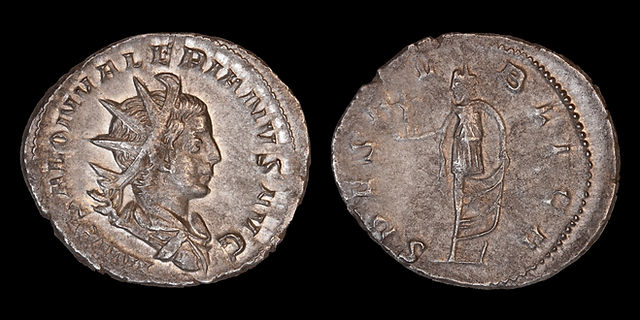
Saloninus, 260 AD. Billon Antoninianus, Cologne, 7th issue; 3.65 g. Draped bust right with radiate crown // Spes standing left with flower. Elmer 108; MIR 917; RIC 14 (Lugdunum); Shiel in ANSMN 24, 1979, cf. pl. 30, 6 ff.; Zschucke 103. Of great rarity. Ex. Fritz Rudolf Künker Auction 235, Osnabrück 2025, lot 9343.
Saloninus (Publius Licinius Cornelius Saloninus Valerianus, d. 260) was the teenage son of the emperor Gallienus and the last male heir of the Valerianic house. In 258 Gallienus named him Caesar (heir apparent) and sent him to the Rhine frontier, where he resided at Colonia Agrippina (Cologne) under the protection and guidance of the senior officer Silvanus. This was a pragmatic move during the Crisis of the Third Century: the northwest provinces faced repeated Germanic incursions, while the emperors themselves were pulled in multiple directions by wars and rebellions.
The immediate conditions that led to Saloninus being hailed as Augustus (emperor) in 260 were local and military. A popular frontier commander, Postumus, had defeated raiders and recovered booty and captives. Silvanus, acting in the name of the imperial government and the young Caesar, demanded that the spoils be turned over—framed as returning property to its owners and/or to the treasury rather than being distributed freely to the soldiers. That demand collided with hard realities on the Rhine: troops expected rewards, felt overextended, and resented distant imperial control. In that charged atmosphere, Postumus’ soldiers proclaimed Postumus emperor instead.
Once Postumus was acclaimed, he marched on Cologne and besieged the city, trapping Saloninus and Silvanus. To preserve legitimacy and rally loyalists, the garrison then acclaimed Saloninus as Augustus, a desperate elevation meant to give the defense a fully “imperial” figurehead against the usurper.
The wider imperial backdrop made this worse: in 260, Gallienus’ father and co-emperor Valerian was captured by the Persian king Shapur I, intensifying instability and encouraging breakaway rulers. Cologne eventually surrendered; Saloninus and Silvanus were handed over and killed, and Postumus went on to found the Gallic Empire.
Due to the circumstances of his elevation, coins of Saloninus as augustus are rare, with about 60 known examples with maybe half of those in private hands. One reason there are not many usurpers in the Roma Aeterna Collections is that their surviving coins are almost uniformly poorly preserved. The portrait on this coin is not so bad, and in fact it is probably the best preserved portrait of Saloninus as augustus that one could obtain.