Julian of Pannonia
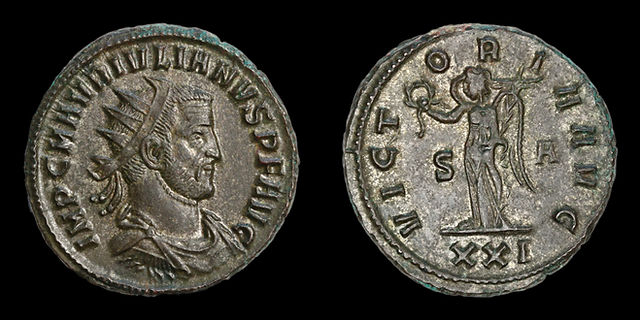
AE Antoninianus, 4.24g. 21mm. Siscia mint, December 284 A.D. IMP C M AVR IVLIANVS P F AVG. Radiate, draped, and curiassed bust of Julian to right. Rev. VICTORIA AVGG; XXI in exergue; S-A in fields. Victory standing to left holding wreath and palm. RIC V, part 2, p. 594,5. Vagi, vol. 1, p.383 (this coin illustrated for the biography of Julian). Ex: Tkalec, Zurich, Auction March 26, 1991, lot 432. Ex: James Fox collection, CNG and NAC, Auction 40, 1996, lot 1725. Ex: CNG Triton XXIX 01/14/2026 lot 844. Ex: Edward J. Waddell inv. No. 58049 02/26/2026.
What can be said about Marcus Aurelius Sabinus Julianus or Julian of Pannonia must be said cautiously, because the surviving evidence is meager and contradictory. In the literary tradition, Julianus appears less as a fully formed ruler than as one more symptom of the empire’s instability in the 280s. The Epitome de Caesaribus says that after Numerian’s death was concealed and then exposed, “Sabinus Julianus took power,” only to be killed by Carinus “at the Veronensian Fields.”
That brief statement suggests Julianus’ bid for power was immediate, opportunistic, and short-lived. He emerged in the confusion following the collapse of Carus’ dynasty, when imperial legitimacy depended less on constitutional process than on speed, troops, and the ability to present oneself as Augustus before rivals could do the same. The literary sources do not preserve a program of government, speeches, laws, or victories. Julianus’ historical importance therefore lies not in achievement but in what his revolt reveals: the Roman state in this period remained vulnerable to rapid military-political fracture.
The material evidence is in some ways more revealing than the texts. His coins present him with the full titulature of an emperor, IMP C M AVR IVLIANVS P F AVG, and at least some issues invoke Pannonia directly, showing the “two Pannonias.” Even if his authority was narrow, he did not represent himself as a mere rebel commander; he claimed the language and symbolism of legitimate imperial rule.
Later testimony complicates the picture. The note to the Historia Augusta preserves an old scholarly problem: Julianus is called M. Aurelianus Julianus there by way of coin evidence, but Sabinus Julianusin the Epitome and in Zosimus; the same note also places his defeat near Verona by Carinus. The difficulty is worsened by the state of Zosimus’ text: Livius notes that eight leaves are lost from the sole manuscript of New History Book 1, meaning that part of the tradition about this period is literally missing.
So a historical judgment on Julianus must remain modest. He was not a stable emperor in the ordinary sense, but a regional claimant who briefly converted provincial or military backing into an imperial title.
His career illuminates a larger truth about the late third-century empire: emperors and usurpers were often separated less by ideology than by success in battle and survival long enough for memory to harden into legitimacy.
Coins of Julian of Pannonia are scarce, as one would expect of a short lived usurper far from Rome. Antoninini of the peroid are routinely found in poor condition and style, so most surviving examples are not pleasing to the eye. This coin is very much an exception. The state fo preservation is excellent and the portrait is quite nice, Even the reverse is nearly fully struck from an unusually fresh die. the coin retains a good fraction of its original silvering both attesting to the modest amount of wear on the coin and providing exceptional eye appeal for the issue. This coin is undoubtedly one of the finest examples of Julian of Pannonia.