Johannes
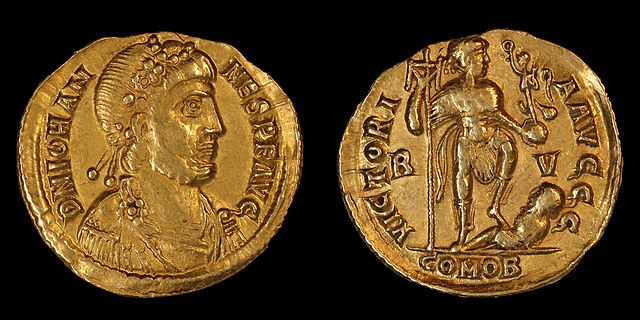
Johannes, 423-425. AV Solidus, Ravenna; 4.46 g. Draped bust facing right with rosette diadem // Emperor standing right, holding standard and Victoria on a globe, his foot resting on a captive. RIC 1901. Of great rarity. Lacam, Civilisation et monnaies Byzantines, Paris 1974, illustrates this piece on plate C and attributes it to an auxiliary mint. Ex. Elsen Auction 62, Brussels 2000, lot 742. Ex. Fritz Rudolf Künker Auction 318, Osnabrück 2019, lot 2048. Ex. Fritz Rudolf Künker Auction 233, Osnabrück 2025, lot 7258.
Johannes, often called Joannes, was a short-lived Western Roman emperor whose reign (20 November 423–May 425) began as a court coup after the death of Honorius. A senior civil servant, the primicerius notariorum (chief of the imperial notaries), Johannes was elevated by powerful western court and military figures (notably the *magister militum* Castinus) during a succession vacuum, but he was never recognized by the Eastern emperor Theodosius II.
Johannes tried to turn usurpation into workable government. Later authors portray him as personally moderate, and his regime struck coinage and sought support from provincial commanders, especially in strategically vital Africa. Yet legitimacy in the 420s still depended heavily on Theodosian dynastic approval, and Theodosius II instead backed the child Valentinian III (son of Galla Placidia) as the western ruler.
In 424–425 the East intervened militarily. Theodosius dispatched an expedition under the general Ardaburius, with his son Aspar operating in Italy; eastern forces seized key positions (including Aquileia) and pressed toward Ravenna, Johannes’s stronghold. With Ravenna isolated and defections encouraged by the invaders, Johannes was captured, publicly humiliated, and executed in 425, ending his bid for the throne.
The episode’s most enduring consequence involved Flavius Aëtius. Sent by Johannes to recruit Hunnic assistance, Aëtius returned with a large Hun force only after Johannes’s fall; he then negotiated with Placidia’s regime, sending the Huns away and receiving high command in Gaul—an arrangement that helped shape western politics for decades. Johannes’s brief reign highlights how fragile western authority had become: emperors could still be made at court, but without eastern recognition and credible armies, they were increasingly vulnerable to rapid intervention—and to the growing leverage of federate forces in Roman civil wars.
Johannes lives in the gray area between usurper and legitimate emperor. Either way, a Johannes solidus is a legitimately rare coin and this one is a very pretty example though it lacks sharpness due to honest wear. A fully choice Johannes solidus, if one ever were to appear on the marketplace, would prohbatively expensive so this one is likely the best example for the Roma Aeterna Collection.