Zeno
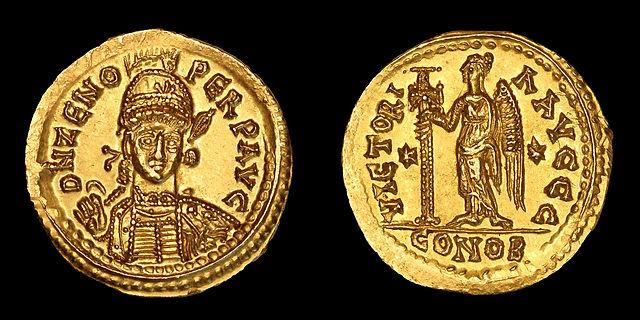
AV Solidus, 4.44g. 20mm. Thessalonica mint. D N ZENO PERP AVG. Facing bust of Zeno with head turned slightly to the right wearing crested helmet and cuirass divided into two panels; he holds spear over right shoulder and carries a shield emblazoned with a horseman device on his left shoulder. Rev. VICTORIA AVGGG; CONOB in exergue. Victory standing to left holding a long jeweled cross with "X" at cross-bar; stars in fields to left and right. RIC X, 941. MIRB 19. DO, LRC 666. Metcalf 228. Ex: Sincona, Zurich, Auction 37, 2017, lot 62. Ex: Edward J. Waddell, Inv. No. 53535, 05/25/2025.
Emperor Zeno, who ruled the Eastern Roman Empire from 474 to 491 AD (with a brief interruption), presided over one of the most turbulent periods in the empire’s history. Born around 425 AD in Isauria (a region in Asia Minor), Zeno rose through the military ranks and married Ariadne, the daughter of Emperor Leo I. This alliance secured his path to power, and upon the death of his young son Leo II in 474, Zeno became the sole ruler.
Zeno’s reign was marked by internal strife, religious conflict, and the final disintegration of Roman authority in the West. His Isaurian origin made him unpopular with the Constantinopolitan elite, and in 475, he was briefly overthrown by Basiliscus, a rival general. Zeno regained the throne in 476 with support from loyal forces and the populace, disillusioned with Basiliscus’ religious policies and misrule.
One of the most significant events during Zeno’s reign was the deposition of the last Western Roman Emperor, Romulus Augustulus, in 476 by the barbarian general Odoacer. Rather than challenge this power shift militarily, Zeno pragmatically acknowledged Odoacer as a nominal subordinate while maintaining de facto Eastern dominance. This effectively ended the Western Roman Empire and made Zeno the sole Roman emperor in name.
Religiously, Zeno tried to unify the empire’s divided Christian factions through the Henotikon in 482, a compromise document aimed at reconciling Chalcedonian and Monophysite Christians. However, it satisfied neither side and led to the Acacian Schism with the Roman Church.
Despite constant revolts and religious discord, Zeno managed to maintain stability in the East. His reign laid the groundwork for the eventual rise of the Byzantine Empire under his successors, especially Anastasius I. Though controversial and often embattled, Zeno played a crucial role in the transformation of the Roman world.
Although the dethroning of Romulus Augustus in 476 AD traditionally marks the end of the Western Roman Empire, because the Eastern emperor Zeno's reign started in 474 AD and thus overlapped with Romulus Augustus he is included in the Roma Aeterna collection. The present Zeno solidus is a mint state coin, bright and lustrous, with impeccable surfaces and strike. A beautiful example of a coin that marks the end of the era of Roman Imperial coinage and the start of the era of Byzantine coinage.