Septimius Severus
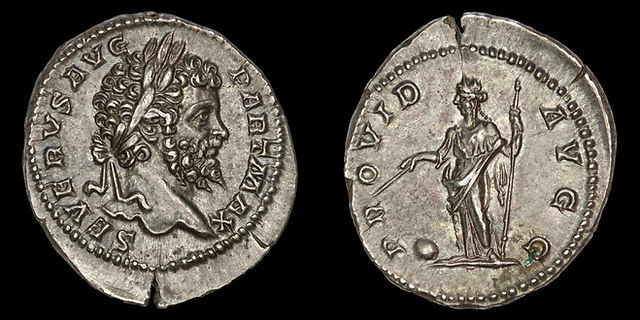
Septimius Severus. AD 193-211. AR Denarius (18mm, 3.53 g, 6h). Rome mint. Struck AD 200-201. Laureate head right / Providentia standing left, holding scepter and wand over globe at feet to left. RIC IV 166; RSC 586. Ex. Triton XXIX, lot 6132, 01/22/2026 (From the Barry N. Rightman Collection.) From the Barry N. Rightman Collection. Ex Galerie des Monnaies (9 June 1978), lot 1787.
Septimius Severus (c. 145–211 CE) ruled as Roman emperor from 193 to 211 and founded the Severan dynasty, steering the empire through civil war and reshaping the balance between army, Senate, and court. Born in Leptis Magna in Roman North Africa, Severus rose through senatorial and military posts to become governor of Upper Pannonia. After the assassination of Commodus and the rapid collapse of the short-lived regime of Pertinax, the empire fractured in 193—the “Year of the Five Emperors.” Severus’ Danubian legions proclaimed him emperor, and he marched on Rome, sidelining the Praetorian Guard and presenting himself as the avenger of Pertinax to legitimize his claim.
Severus then eliminated rival emperors in sequence. He first neutralized Didius Julianus in Rome, then turned east against Pescennius Niger, defeating him decisively by 194. Next he confronted Clodius Albinus in the West, who had been a tentative ally; the conflict culminated in a major battle at Lugdunum (Lyon) in 197, after which Severus emerged as sole ruler.
With internal opposition crushed, Severus emphasized military strength and dynastic continuity. He raised soldiers’ pay, expanded benefits, and relied heavily on the loyalty of the legions, policies that secured stability but increased fiscal pressure. His reign also elevated the influence of his wife Julia Domna and a powerful imperial court, while the Senate’s political role continued to diminish.
In foreign affairs, Severus campaigned against Parthia, capturing Ctesiphon in 197 and creating or strengthening Roman control in northern Mesopotamia. Later he undertook a major expedition to Britain (208–211), aiming to consolidate the northern frontier beyond Hadrian’s Wall through aggressive campaigning and fortification.
Severus died at Eboracum (York) in 211, leaving the empire to his sons Caracalla and Geta, urging them to maintain harmony and reward the soldiers. His legacy is that of a hard-headed soldier-emperor whose reforms reinforced imperial authority through the army—effective in the short term, but contributory to the longer-term militarization of Roman politics.
There are many nice examples of Septimius Severus. In fact the Roma Aeterna collection owned a choice, lustrous, mint state example for about one hour before it was stolen at the NYINC convention in 2024. The present coin is not as technically perfect but it is far more charming. It is struck in very high relief for the issue, with gorgeous original gray toning. The portrait is highly detailed. The flan is unusually large for a denarius so the legends are fully present and the beaded border is nearly intact.