Marcus Aurelius
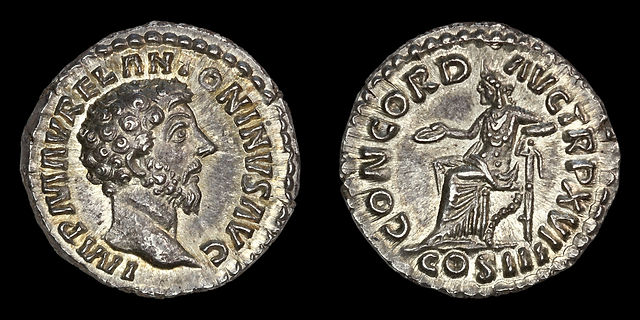
Marcus Aurelius. AD 161-180. AR Denarius (17.5mm, 3.19 g, 11h). Rome mint. Struck under Marcus Aurelius and Lucius Verus, AD 162. Bare head right / Concordia seated left, holding patera and resting arm on statuette of Spes; cornucopia below seat. RIC III 35; MIR 18, 32-4/10; RSC 35. Ex. Triton XXIX, lot 6102, 01/22/2026 (From the Barry N. Rightman Collection). Ex Schweizerische Kreditanstalt 3 (19 April 1985), lot 593.
Marcus Aurelius (121–180 CE) ruled as Roman emperor from 161 to 180 and is remembered as both a capable statesman and the most famous “philosopher-emperor.” Adopted into the Antonine dynasty and trained for public life under Antoninus Pius, he came to power in 161 as co-emperor with Lucius Verus, a rare arrangement that reflected dynastic planning and the demands of governing a vast empire. Marcus is best known for combining a strong sense of duty with Stoic ethics, later expressed in his Meditations, a private notebook of reflections on self-control, mortality, and acting in accordance with reason.
His reign was dominated by war and crisis. In the East, conflict with Parthia (161–166) ended in Roman victory under Verus’ generals, but returning troops helped spread the Antonine Plague, a devastating epidemic that strained manpower, finances, and social stability for years. On the northern frontiers, Marcus spent much of the later 160s and 170s fighting the Marcomannic Wars against Germanic and Sarmatian groups along the Danube. These campaigns, waged under harsh conditions, forced him to remain with the army for long stretches and to manage the empire’s resources carefully, including raising funds through extraordinary measures and emphasizing imperial resilience.
At home, Marcus worked within the established administrative traditions of the “good emperors,” relying on the Senate, legal expertise, and a generally conservative approach to governance. His reign also saw localized persecutions of Christians, though policies varied by region and were often driven by provincial pressures rather than a single empire-wide directive.
In 175, Marcus faced a major internal shock when Avidius Cassius, a senior commander, rebelled in the East; the revolt collapsed quickly, and Marcus’ response was notably restrained. Marcus died in 180 during campaigns on the Danube (commonly at or near Vindobona), leaving the throne to his biological son Commodus. The succession ended the long pattern of adoptive emperors and is often seen as a turning point from the relative stability of the Antonine age toward the turbulence of the third century.
The coins of Marcus Aurelius have fairly uniform portraiture of average style. As they are quite common, the challenges lies in waiting for an unusually nice example to appear. This coin is pretty close to mint state, with luster and a pleasant tinge of colorful toning.